News
Do we need put an earth ring to permanent magnet motor of a screw air compressor please?
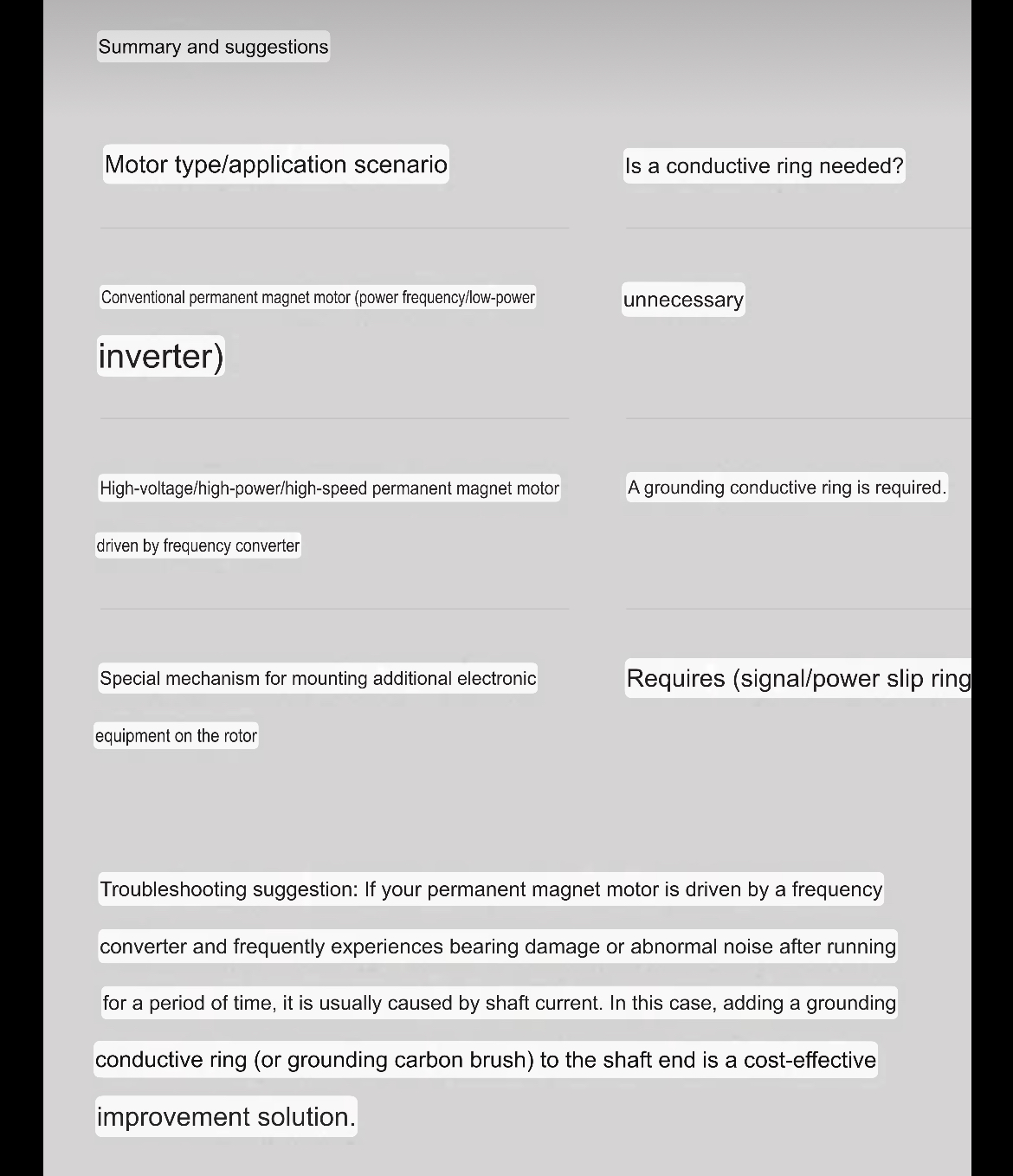
Most standard permanent magnet motors do not require conductive rings (collector rings or slip rings); however, specific applications or high-specification motors may necessitate them (e.g., grounding carbon brushes or conductive grounding rings).
Determining whether installation is necessary depends on whether your specific requirement is for "current transmission" or "shaft current protection":
1. Why do the vast majority of permanent magnet motors *not* require conductive rings?
Determined by operating principle: In permanent magnet motors (such as PMSMs or BLDC motors), the rotor's excitation magnetic field is provided by permanent magnets (e.g., NdFeB).
Brushless structure: Three-phase AC is supplied to the stator to generate a rotating magnetic field; the rotor passively follows this rotation driven by the permanent magnets. The rotor itself contains no coils requiring a power supply. Consequently, there is no need to supply power to the rotor via conductive rings and carbon brushes, as is required for traditional excited synchronous motors or wound-rotor asynchronous motors.
2. Under what special circumstances *is* it necessary to add conductive rings (grounding rings/collector rings)?
Although conductive rings are not needed for rotor power supply, special conductive rings may be required or necessary in the following two scenarios:
Scenario 1: Preventing bearing damage caused by "shaft currents" in VFD-driven motors (most common)
In high-power or high-speed permanent magnet motors driven by variable frequency drives (VFDs/PWM), high-frequency switching signals generate common-mode voltage, inducing high-frequency shaft voltage on the motor shaft.
Hazard: The shaft voltage penetrates the bearing oil film, creating shaft current that leads to bearing electrical erosion (manifesting as electrical pitting, rumbling noises, and eventual seizure).
Solution: Install a shaft grounding brush or grounding conductive ring (such as a conductive fiber ring or carbon brush) at the shaft end. This safely diverts induced static electricity and high-frequency currents from the shaft to the ground, thereby protecting the bearings.
Scenario 2: The need to transmit signals or power from the rotor side
If your system involves a complex rotating platform where the rotor carries additional equipment requiring power or signal transmission (for example):
Sensors, heaters, or electromagnets requiring a power supply are mounted on the rotor. A rotary encoder is integrated into the rotor, requiring the signal to be routed to the stationary side.
In this scenario, a signal/power slip ring (conductive collector ring) must be installed on the shaft; however, this serves to provide power or communication for auxiliary equipment on the rotor, rather than meeting the operational requirements of the motor itself.
Summary and Recommendations


 Send Email
 Skype
Skype WhatsApp